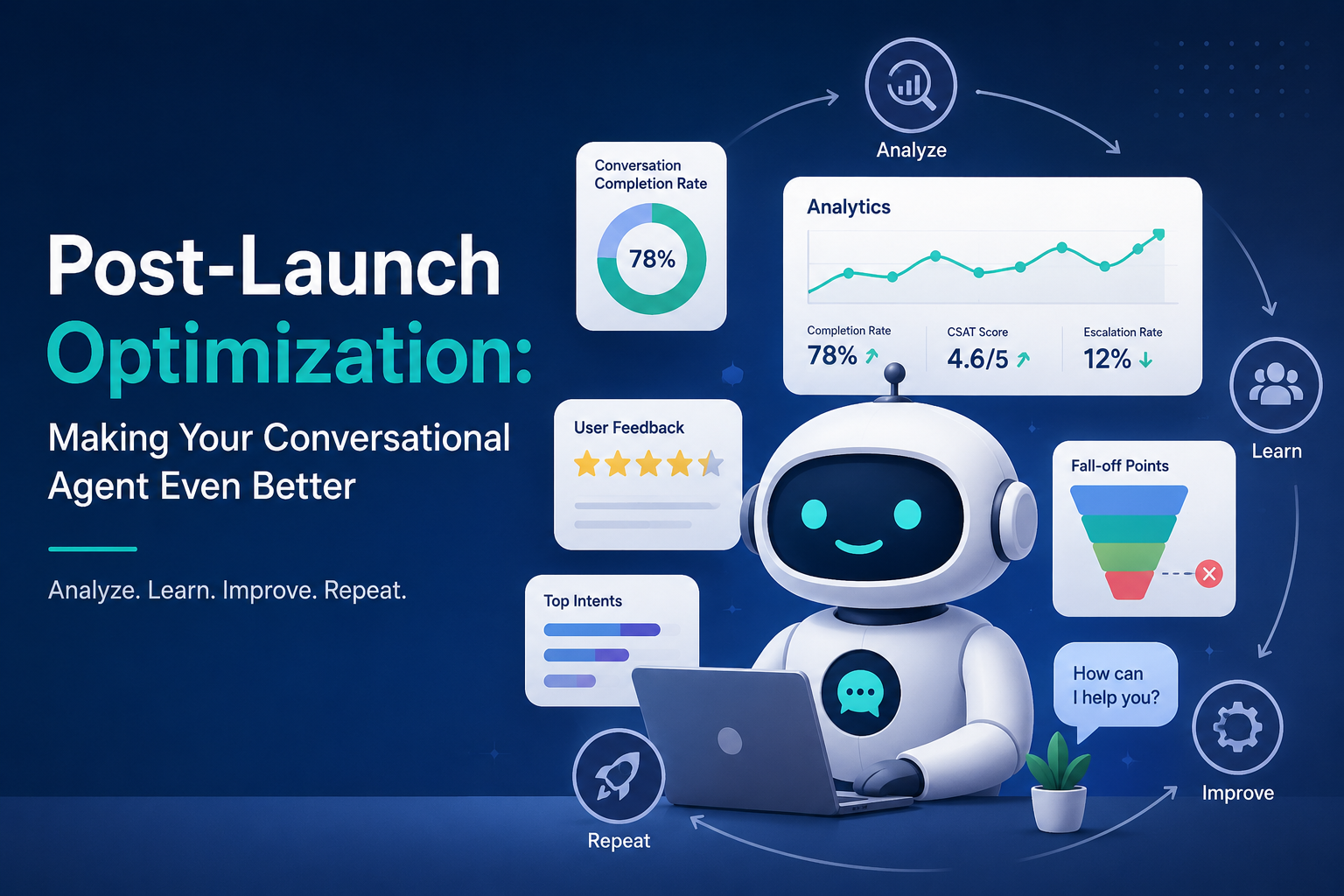
Post-Launch Optimization: Making Your Conversational Agent Even Better
📌 What you'll learn today
This guide explains how to continuously improve your conversational agent after it's live, focusing on data analysis, user feedback, and iterative enhancements.
Post-Launch Optimization: Making Your Conversational Agent Even Better
Congratulations! You've successfully launched your conversational agent, a digital assistant designed to interact with your users. This is a significant achievement. However, the work doesn't stop here. In fact, the launch is just the beginning of a crucial phase: post-launch optimization. Think of it like releasing a new product – you wouldn't just put it on the shelves and forget about it, right? You'd want to gather feedback, see how people are using it, and make improvements. The same applies to your conversational agent.
Post-launch optimization is the ongoing process of monitoring, analyzing, and refining your conversational agent to ensure it's performing optimally, meeting user needs, and achieving your business objectives. It's about moving from 'good enough' to 'excellent' and ensuring your agent remains relevant and effective in a constantly evolving digital landscape.
Why is Post-Launch Optimization So Important?
Several key reasons highlight the necessity of this phase:
- User Expectations are High: Users today expect seamless, efficient, and personalized interactions. If your agent isn't delivering, they'll quickly disengage or seek alternatives.
- Unforeseen Issues: No matter how thorough your testing, real-world usage can reveal bugs, edge cases, or misunderstandings you didn't anticipate.
- Evolving Needs: User needs and business goals aren't static. Your agent must adapt to these changes to remain valuable.
- Competitive Landscape: Your competitors are likely optimizing their own agents. Staying ahead requires continuous improvement.
Core Concept 1: Data Analysis is Your Compass
The most powerful tool in your optimization arsenal is data. Your conversational agent generates a wealth of information about user interactions. Analyzing this data is crucial for understanding what's working and what's not.
Key Metrics to Track:
- Conversation Completion Rate: What percentage of conversations result in a successful resolution for the user? A low rate indicates users aren't getting the answers or completing the tasks they intended.
- Fall-off Points: Where are users abandoning conversations? Identifying these points can reveal confusion, dead ends, or areas where the agent lacks sufficient understanding.
- User Satisfaction Scores (NPS/CSAT): If your agent includes a feedback mechanism, track user satisfaction. This is direct qualitative data.
- Intent Recognition Accuracy: How often does the agent correctly understand the user's intent? Low accuracy leads to frustration and irrelevant responses.
- Average Handling Time: For task-oriented agents, a decreasing handling time can indicate increased efficiency.
- Escalation Rate: How often do conversations need to be handed over to a human agent? A high escalation rate might suggest the agent isn't equipped to handle certain queries.
Example: Identifying a Fall-off Point
Let's say your e-commerce agent is designed to help users track orders. You notice a significant number of users drop off when asked for their "order number." Upon investigation, you find that many users don't have their order number readily available, and the agent doesn't offer alternative ways to find their order, such as by email address or shipping address. This data point directly informs an optimization: add alternative lookup methods.
Core Concept 2: User Feedback is Your Voice of the Customer
While data tells you *what* is happening, user feedback tells you *why*. Actively solicit and listen to what your users are saying about their experience with the agent.
Methods for Gathering Feedback:
- Post-Conversation Surveys: Short, targeted questions immediately after a conversation can capture fresh insights. Examples include: "Was this helpful?" or "Did you find what you were looking for?"
- Direct Feedback Channels: Implement a "Suggest an Improvement" or "Report an Issue" button within the agent interface.
- User Interviews/Focus Groups: For deeper qualitative understanding, conduct structured interviews or focus groups with a segment of your user base.
- Sentiment Analysis of Chat Logs: Beyond explicit feedback, analyze the tone and language used in chat logs to gauge overall user sentiment.
Example: Using Feedback to Improve Greetings
Your agent might be programmed with a very formal greeting. Users might leave feedback like, "It felt a bit stiff," or "I didn't know where to start." This feedback can prompt you to adjust the greeting to be more conversational and include clear prompt options, like "Hi there! How can I help you today? You can ask me about your order status, product information, or shipping details." This small change can significantly improve initial engagement.
Core Concept 3: Iterative Enhancement – The Cycle of Improvement
Optimization isn't a one-time fix; it's a continuous cycle. You analyze data, gather feedback, implement changes, and then repeat the process.
The Optimization Cycle:
- Monitor & Analyze: Regularly review your key metrics and user feedback.
- Identify Opportunities: Pinpoint areas for improvement based on your analysis. This could be a specific intent that's not being recognized, a confusing dialogue flow, or a common user frustration.
- Prioritize & Plan: Determine which improvements will have the biggest impact and are feasible to implement.
- Implement Changes: Update your agent's logic, training data, responses, or functionalities. This might involve adding new intents, refining existing ones, improving natural language understanding (NLU) models, or enhancing the user interface.
- Test & Deploy: Rigorously test your changes to ensure they don't introduce new issues. Then, deploy them to your live agent.
- Measure Impact: After deployment, monitor your metrics again to see if the implemented changes have had the desired effect.
Example: Enhancing a 'Return Policy' Intent
You notice that when users ask about the "return policy," the agent often provides a generic link, but many follow-up questions indicate users are still confused about specific conditions (e.g., "Can I return an item after 30 days?" or "What if the item is damaged?"). Your data shows a high number of subsequent questions for this intent. The optimization could involve:
- Expanding the training data for the 'return policy' intent to include these specific scenarios.
- Updating the agent's responses to proactively address common sub-questions within the initial answer.
- Potentially creating new, more specific intents like 'return window' or 'damaged item return' if the complexity warrants it.
By iterating and refining, the agent becomes more comprehensive and reduces the need for users to ask multiple follow-up questions.
Real-World Company Example: A Major Airline
A leading airline implemented a conversational agent to handle common customer queries like flight status, booking changes, and baggage allowance. Initially, they saw a moderate success rate. However, through rigorous post-launch optimization, they focused on analyzing user utterances that the agent failed to understand. They discovered a recurring pattern of users asking about "seat upgrades" in a variety of colloquial ways (e.g., "can I get a better seat?", "more legroom please", "business class upgrade?"). By adding these specific phrases to the 'seat upgrade' intent's training data and refining the agent's ability to ask clarifying questions about preferred class and willingness to pay, they saw a 15% increase in successful seat upgrade bookings initiated through the agent and a 10% reduction in calls to their contact center for this specific query within the first quarter of implementing these changes.
Key Takeaways
Post-launch optimization is not an optional extra; it's a fundamental part of ensuring your conversational agent's success. By embracing data analysis, actively listening to user feedback, and committing to an iterative enhancement process, you can transform your agent from a functional tool into a highly effective and indispensable asset.
Start small, but start now.
Don't wait for perfection. Launch, monitor, learn, and improve. Your users (and your business) will thank you for it.
⭐ Key Takeaways
- ✓Post-launch optimization is the continuous process of refining your conversational agent after it goes live.
- ✓Key metrics like conversation completion rate, fall-off points, and intent recognition accuracy are vital for identifying areas of improvement.
- ✓Actively gathering user feedback through surveys, direct channels, and sentiment analysis provides crucial 'why' behind the data.
- ✓The optimization cycle (monitor, identify, plan, implement, test, measure) ensures ongoing improvement.
- ✓Iterative enhancements, like refining intent training data and response logic, are key to transforming agent performance.
About the Author

🌍 Real-World Example
A major airline focused on optimizing their conversational agent by analyzing misunderstood user queries related to seat upgrades. By expanding the training data for this intent and improving clarification questions, they achieved a 15% increase in successful upgrade bookings via the agent and a 10% reduction in contact center calls for this issue.
🧠 Quick Knowledge Check
Q1. Which of the following is NOT a key metric to track during post-launch optimization?
Q2. What is the primary purpose of analyzing user feedback in post-launch optimization?